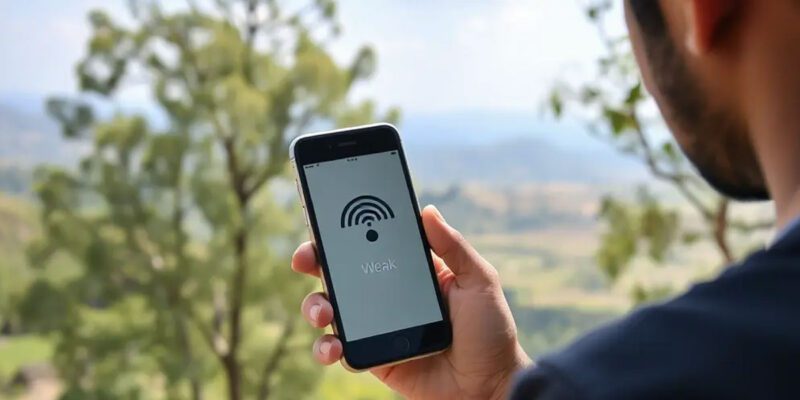
How to Make Your Phone Work Better in Rural Areas With Poor Signal
 By
By Rural phone coverage is genuinely worse than urban coverage and that’s not something settings changes can fully overcome — the physics of cellular signal and the economics of tower deployment mean that some areas will always have limited coverage. But there’s a significant gap between making the most of available signal and the poor experience most people have by default.
Understanding What You’re Working With
Before trying to fix anything, understand what signal is available in your area. Coverage maps from your carrier give you a rough idea but are optimistic. The more useful test is the field test mode on your phone, which shows actual signal strength in dBm (decibels relative to milliwatt).
On iPhone: dial *3001#12345#* and press call. In the resulting screen, look for the signal values — around -80 dBm is good, -100 is poor, -110 is barely functional.
On Android: Settings > About Phone > Status > SIM Status > Signal Strength.
This tells you whether the signal issue is “weak signal” (-90 to -100) which may be improvable, or “essentially no signal” (-110 and below) which requires a different solution.
Carrier and Network Selection
Different carriers have different rural coverage. In the US, AT&T and Verizon generally have better rural coverage than T-Mobile in most areas, though this varies by specific location. In the UK, EE generally has the best rural coverage.
If you’re consistently in areas where your carrier has poor coverage, switching carriers is the most effective solution. Check coverage maps for each carrier at your specific rural address and at locations you frequent.
Network mode setting: Settings > Connections > Mobile Networks > Network Mode. In areas with no 5G or 4G coverage, setting to “LTE/4G Only” or “3G/2G/Auto” prevents the phone from endlessly searching for 5G signal it can’t find, which drains battery and can reduce connection stability.
Wi-Fi Calling: The Rural Game Changer
If your rural home or farm has broadband internet — even a satellite connection — Wi-Fi Calling transforms the experience. Enable it (Settings > Connections > Wi-Fi Calling on Android; Settings > Phone > Wi-Fi Calling on iPhone) and your calls and texts route through the internet rather than cellular.
With good broadband, Wi-Fi Calling provides consistent, high-quality voice communication even in locations with zero cellular signal. This is the single most impactful change for rural users with any form of broadband.
Signal Boosters
Mobile signal boosters are legal devices that amplify existing cellular signal inside a building. They consist of an outdoor antenna pointed toward the nearest cell tower, an amplifier, and an indoor antenna. They can provide dramatically improved indoor coverage from signal that’s marginal outside.
In the US: sure-fire brands include weBoost, SureCall, and HiBoost — all FCC-approved. Installation costs $250-600 for home installations. Requires at least some signal outside the building to amplify.
In the UK: Ofcom-approved boosters are legal (specific frequency bands only). Mobile operators in the UK offer a Femtocell/Sure Signal service (small indoor unit that connects to your broadband) for customers with poor coverage.
Satellite Connectivity
For truly remote areas with no cellular coverage, satellite connectivity has become increasingly practical.
iPhone 14 and later: Emergency SOS via Satellite allows emergency messaging without any cellular coverage. Not suitable for regular communication but genuinely lifesaving in emergency situations.
Starlink: provides broadband internet via satellite that you can then use with Wi-Fi Calling for voice and data. The latency has improved to workable levels for voice calls.
For regular voice communication in areas without any cellular coverage, a satellite phone (Iridium, Thuraya) remains the most reliable option, though costs are higher than cellular.
Managing Battery in Low Signal Areas
Phones expend significantly more battery searching for signal in poor coverage areas — the cellular radio runs at higher power trying to maintain a connection. In areas where you know signal is unavailable, enabling Airplane Mode and switching to Wi-Fi only (if available) can extend battery life substantially. You won’t miss cellular calls if you’re on Wi-Fi Calling.
Views: 17

You may also like

How to Use Your Phone to Stay Financially Organised During a Life Event

How to Use Your Phone to Stay Motivated When You Feel Like Giving Up

How to Use Your Phone to Get More From Your Doctor’s Appointments
More in:Gadgets

How to Use Your Phone to Create and Stick to a Weekly Meal Plan
How to Use Your Phone to Research and Buy a Used Car Safely
How to Use Your Phone to Stay Safe and Informed During Bad Weather

TecRounder is a blog that shares New Technology news from around the world (hence the name TecRounder), including the most recent mobile and gadget information: smartphone features, specifications, and more. You can find the latest technology updates here, including the most recent information on smartphones, laptop computers, and other electronic devices.